

Cigar Houses
Montecristo: The Habano Named After a Novel
A Havana cigar maker, a Dumas novel read aloud to the rollers and a family that had to start over in exile.
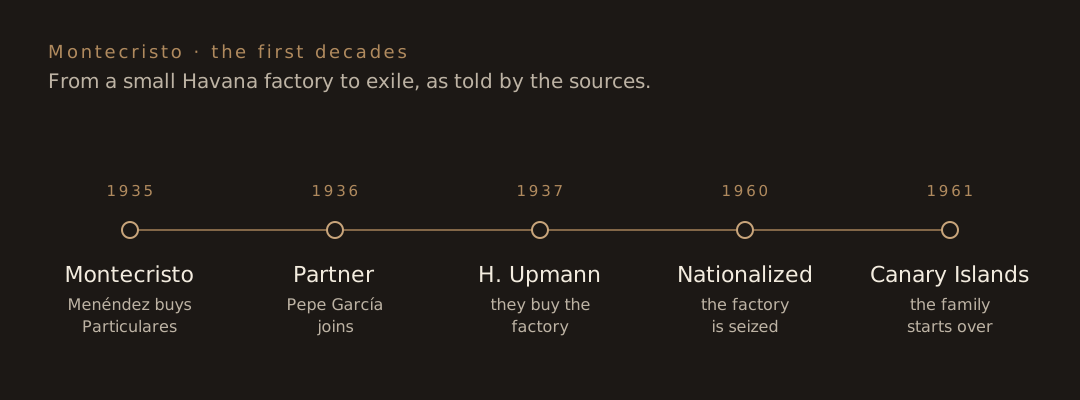
Illustration: CigarSolace.
Few brands have a name with so much history. Montecristo comes from a novel, the one Havana’s rollers most liked to hear.
A factory and a novel
In July 1935, cigar maker Alonso Menéndez bought the Particulares factory in Havana, which made the Particulares and Byron brands. Right away he created a new brand: Montecristo.
The name comes from Alexandre Dumas’s The Count of Monte Cristo. In Cuban factories, a lector read aloud to the rollers while they worked, and that novel was one of their favorites. Some books say the brand was first called “H. Upmann Montecristo Selection,” but other sources call that a myth, because the company did not yet own H. Upmann.
Menéndez, García and H. Upmann
In 1936 Menéndez took on a partner, José Manuel “Pepe” García, a former sales manager at Partagás, and together they formed Menéndez, García y Cía. In 1937 they bought the H. Upmann factory and moved Montecristo production there. That factory stayed the brand’s home even after the revolution.
Revolution and exile
After the revolution, Castro’s government nationalized the factory, the brand and all its assets. Most sources give September 15, 1960; others say 1961.
The family went to the Canary Islands and in 1961 opened a new company in Las Palmas. Because the Cuban Montecristo was sold there, Menéndez and his son Benjamín had to come up with another name: Montecruz. Over the years, trademark disputes with Cubatabaco forced them to leave the Canaries.
Meanwhile, in Cuba, Montecristo carried on and became one of the most famous Habanos in the world, above all for the No. 2, a torpedo, and the No. 4, a corona.
Two Montecristos
As with Cohiba, today there are two Montecristos. One is made in Cuba for Habanos S.A. The other is made in La Romana, Dominican Republic, for the U.S. market, and its story runs through Consolidated Cigar, which bought the Canary Islands company in 1972 and moved its production to the Dominican Republic, and through Altadis.
Why it matters
Montecristo brings together two very Cuban things: the tradition of the lector in the factory and a family that had to rebuild itself in exile. And his son Benjamín, “Benji” Menéndez, stayed in the trade for more than six decades.
Some dates in this story vary by source. We say so where they disagree.
The conversation
What do you think?
Share what you think about this story. Agreement and disagreement are both welcome.