

Storage
Humidors and Humidity. How to Keep Cigars at Their Best
The humidity and temperature cigars like, how to season a new humidor, which humidification to use, and the warning signs of a cigar that is too dry or too wet.
A cigar is made of leaf that is still alive in a sense: it takes in and gives off moisture with the air around it. Store it too dry and it burns hot, harsh and fast, and the wrapper can crack. Store it too wet and it draws poorly, struggles to stay lit and can grow mold. A humidor exists to keep that balance steady.
The numbers to aim for
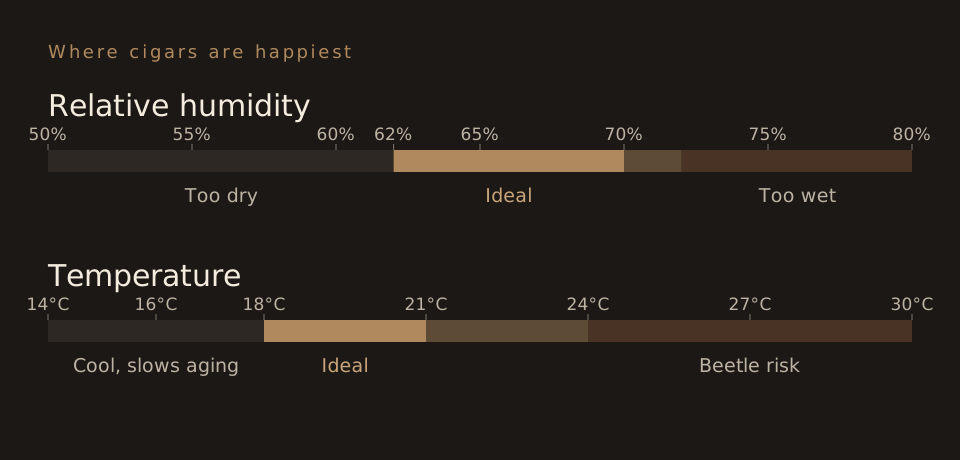
- Humidity: most smokers keep their cigars between 65% and 70% relative humidity. Many prefer the lower end, around 62–65%, because cigars burn and draw more easily. Experiment within that range and keep the one you like.
- Temperature: around 18–21 °C (65–70 °F). Above roughly 24 °C (75 °F), especially with high humidity, the risk of tobacco beetles hatching rises sharply.
Stability matters more than precision. A humidor that stays at 66% every day is better than one that swings between 60% and 72%.
What makes a good humidor
- Spanish cedar lining. It holds moisture well, resists mold and adds a gentle aroma.
- A tight seal. Close the lid and it should fall softly on a cushion of air.
- A hygrometer to read the humidity, ideally digital.
- A humidification source.
Seasoning a new humidor
New cedar is dry and will pull moisture out of your cigars. Season it before you put a single cigar inside.
- Lightly wipe the interior wood with a clean cloth dampened with distilled water. Damp, not wet. Never pour water in or soak the wood.
- Place your charged humidification device inside, close the lid, and leave it.
- Wait until the hygrometer holds steady in your target range, usually somewhere between a couple of days and a week.
- Then add your cigars, a few at a time if you have many.
Always use distilled water or a propylene glycol solution made for humidors. Tap water leaves minerals behind and can encourage mold.
Choosing humidification
- Two-way humidity packs release or absorb moisture to hold a set level, commonly sold at 62%, 65%, 69% or 72%. They are the easiest choice for most people. Replace them when they turn hard.
- Foam or crystal gel devices are refilled with distilled water or humidor solution. They work well but need regular checks.
- Electronic humidifiers suit larger cabinets and collections.
Calibrate your hygrometer
Hygrometers drift. The simple salt test checks yours: put a little table salt in a bottle cap, add a few drops of water to make a damp paste (not a liquid), and seal it in a zip bag with the hygrometer for about 24 hours. A sealed space with damp salt settles at about 75%. If your hygrometer reads 72%, it reads 3 points low. Adjust it or remember the difference.
Warning signs
- Too dry: the wrapper feels papery or cracks, the cigar burns hot and fast, flavors turn sharp.
- Too wet: the cigar feels spongy, the draw is tight, it keeps going out, the burn tunnels.
- Mold: fuzzy blue, green or white spots that smear. Remove the affected cigars and find the cause, usually humidity that is too high.
- Plume (bloom): fine white crystals that brush off easily. Many consider it harmless oils from aging. If in doubt, a magnifying glass helps tell it from mold.
- Tobacco beetles: tiny pinholes in the wrapper. Remove the affected cigars immediately. Freezing them is a common way to kill eggs, with a gradual return to room temperature afterwards.
Small habits that help
- Rotate cigars now and then so all of them get even air.
- Keep different sizes and strengths together if you like, but separate infused or aromatic cigars, as their scent spreads.
- Keep the humidor away from sunlight, heaters and outside walls.
- Open it only when you need to.
A well-kept humidor is quiet work. It rewards you every time you light a cigar that burns exactly the way it should.