

Guides
How to Use ChatGPT or Any AI as an Assistant to Learn About Cigars
Your palate first. The reference after. My method for using ChatGPT, Claude or any AI as an assistant to learn about cigars, without letting it tell you what you should taste.
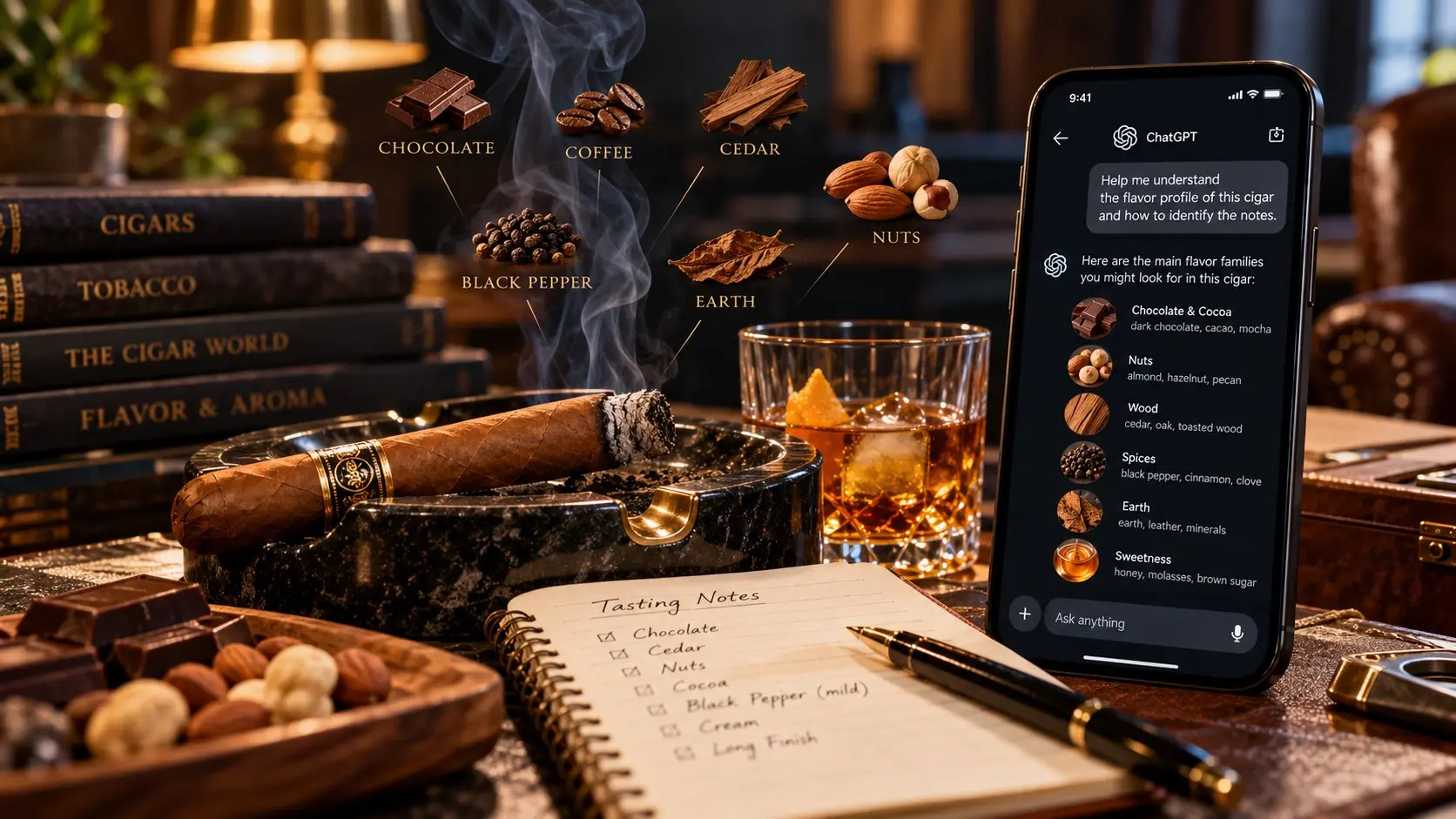
Learning to smoke premium cigars is not about memorizing tasting notes.
Nor is it about reading a review before you light up and trying to find exactly the flavors someone else found.
For me, learning about cigars has been a much more personal process: trying, paying attention, comparing experiences, and little by little understanding what my palate truly enjoys.
Along the way I discovered that artificial intelligence can become an extraordinarily useful tool.
Not to tell you what you should taste. Not to replace your experience. But to help you understand it.
AI as an assistant, not a judge
When I use ChatGPT while trying a cigar, I am not simply asking: “What does this cigar taste like?”
That question can be useful as a reference, but it can also create suggestion. If, before I light a cigar, someone tells me I will find chocolate, espresso, hazelnut, cinnamon and leather, there is a good chance I will start looking for them, even if they are not necessarily the first things my palate would have picked up.
That is why my method starts from a simple idea:
First I experience. Then I use AI to help me interpret what I experienced.
Artificial intelligence works best as a second pair of eyes (or in this case, a second conceptual palate) that helps put words to sensations we often do not yet know how to describe.
Step 1: identify the cigar correctly
It all starts with understanding what you are holding. You can take a photo of the cigar or write down its:
- brand
- line
- vitola
- size
Then you can ask the AI to help you identify:
- country of manufacture
- wrapper, binder and filler
- approximate strength
- type of tobacco
- general characteristics of the blend
This context helps a lot, because you start connecting certain tobaccos with past experiences. Over time you can begin to recognize, for example, how a San Andrés wrapper behaves compared with a Connecticut, Habano, Corojo or Broadleaf.
Step 2: ask what you might find, not what you will find
This difference matters. Instead of “Tell me the notes of this cigar”, I prefer to ask:
“Which flavor families usually show up in this blend, and what could I pay attention to without conditioning myself too much?”
The AI can then give you some general categories: cocoa or chocolate, coffee, nuts, cedar or wood, natural sweetness, earth, leather, spice, toast, dark fruit or minerality.
That works as a map, not as an answer.
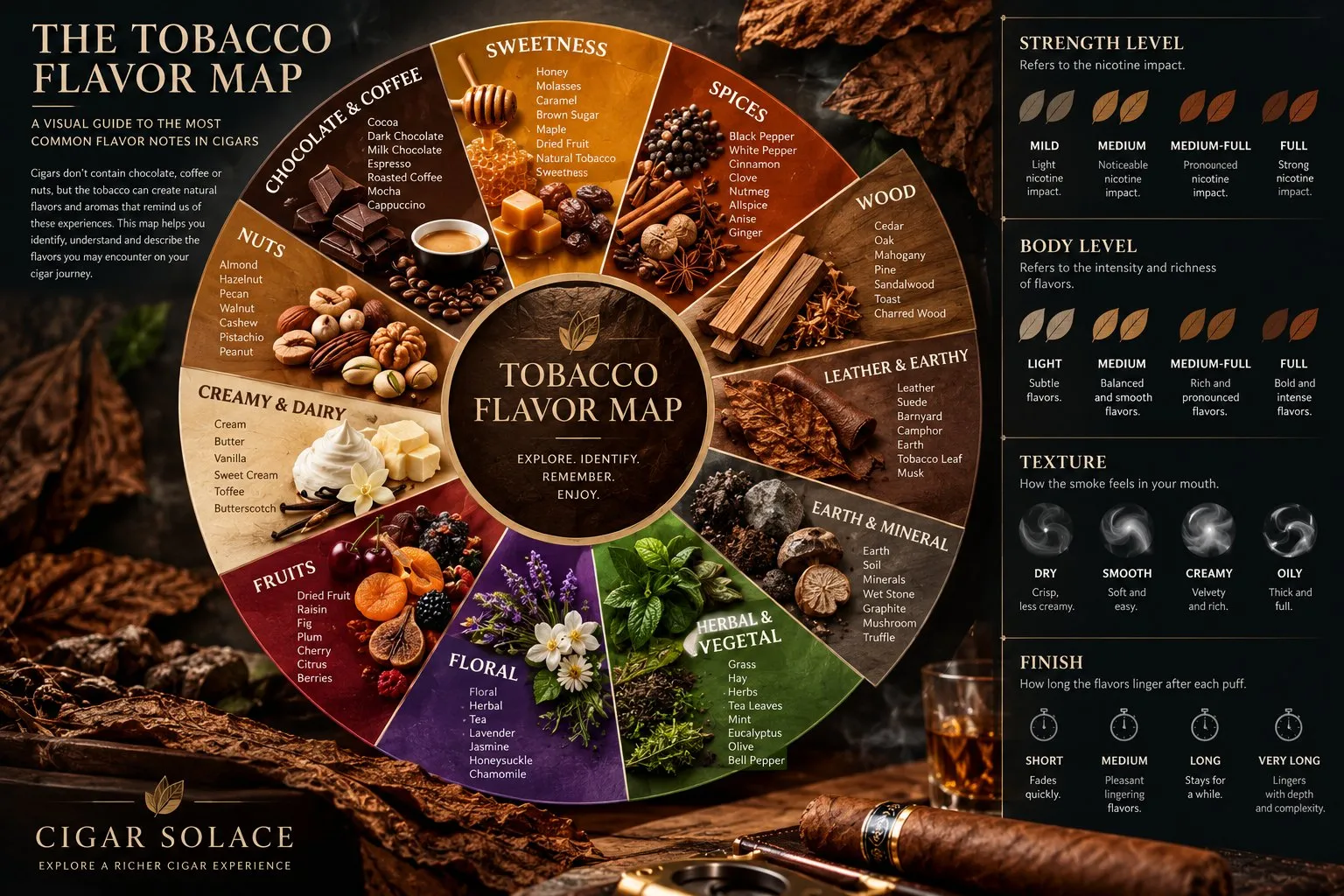
Image: CigarSolace.
Step 3: smoke first and describe it in simple words
You do not need to talk like a sommelier. In fact, at the beginning it is better not to. You can say things like:
- “It tastes sweet, but I don’t know what kind.”
- “There’s something toasty.”
- “I feel some heat, but I don’t know if it’s pepper or cinnamon.”
- “It reminds me of coffee.”
- “It’s drier than I expected.”
That is where AI can be really useful, because it can help you tell things apart:
- Is that sweetness closer to honey, molasses, caramel, brown sugar or dried fruit?
- Does the heat feel like black pepper or white pepper? Or is it a spice such as cinnamon or clove?
- Does the coffee recall espresso, roasted coffee, mocha or black coffee?
With questions like these, you slowly build a sensory vocabulary.
Step 4: split the smoke into stages
Not every cigar evolves much. Some are fairly linear. But observing a cigar in stages helps build memory. You can take notes for each third.
First third
What showed up right away? What was your first impression?
Second third
Did anything change? Did nuts appear? More sweetness? More body?
Final third
Did it get stronger? More bitter? Sweeter? More indulgent? Drier?
In my experience, this part can completely change how I perceive a cigar. A cigar can start out fine and finish extraordinary. Another can start out spectacular and lose its balance at the end.
Step 5: pay attention to texture, not only flavor
Something I learned over time is that two cigars can share exactly the same notes and feel completely different. Chocolate, coffee and cedar can show up in many cigars. But one can feel creamy, silky and round, while another feels dry, rough, intense and astringent.
That is why I also ask the AI to help me notice things like:
- smoke texture
- creaminess
- density
- dryness
- temperature
- length of the finish
- mouthfeel
This helps enormously in understanding why you enjoy one cigar more than another, even when they share similar flavors.
Step 6: tell body apart from strength
This was another important distinction in my learning.
- Body is the intensity of the flavors.
- Strength is how much you feel the nicotine and the physical intensity of the cigar.
You can smoke a cigar full of flavor that is not necessarily very strong. Understanding this helps you describe the experience better.
Step 7: record the construction too
The experience is not only flavor. I also watch:
- draw
- burn line
- smoke output
- ash
- need for touch-ups
- consistency of the burn
But I try not to confuse construction with preference. A cigar can be perfectly built and still not be for me. And that is fine.
Step 8: teach the AI your palate
This is where the process becomes really interesting. After enough cigars, you can ask ChatGPT to find patterns.
In my case, for example, I have been able to see that I tend to connect strongly with profiles that show:
- cocoa
- coffee
- nuts
- cedar
- controlled natural sweetness
- good integration
- medium to medium-full strength
- pepper that is present but not dominant
While I generally connect less with:
- persistent bitterness
- excessive dryness
- dominant black pepper
- overly heavy earth
- strong salty profiles
That does not mean a cigar with those traits is bad. It simply means it may be less aligned with my palate. That distinction is fundamental.
Quality is not the same as preference
This has probably been one of my most important lessons.
You can smoke a perfectly built cigar and recognize that it is very well made, yet simply not want to smoke it again. You can also find a technically less complex cigar that connects with you perfectly.
AI can help you separate those two things. You can say:
“I recognize this cigar is very well executed, but it is not necessarily aligned with my palate.”
That is completely valid.
Step 9: use comparison as a learning tool
After trying several cigars, start comparing them:
- “This one had chocolate like the last one, but here it was sweeter.”
- “This one had coffee, but more espresso than roasted coffee.”
- “The last one was creamier.”
- “This one evolved better.”
- “This one had black pepper, but much better integrated.”
Those comparisons are what really build sensory memory.
Step 10: use AI to help you write your notes
After smoking, you can give ChatGPT all your impressions and ask:
“Organize these notes without adding any flavors I haven’t mentioned.”
That last part matters. AI should help you express your experience, not replace it.
You can turn messy notes like:
“Strong chocolate at first, then almonds, good ash, black pepper but not annoying, richer at the end.”
Into something like:
“From the first draws, an intense, well-defined chocolate appeared. Black pepper was present but well controlled. In the second third, almonds and nuts came forward while the construction stayed flawless. The final third gained richness and depth without losing balance.”
The experience is still yours. AI simply helps you communicate it.
An important warning: avoid suggestion
Artificial intelligence can be as useful as it is risky for developing your palate. If before smoking you ask “Which exact notes will I find?”, you may end up chasing flavors.
My advice is to ask for general information before you smoke, and do the deeper analysis after you have formed your first impressions.
Your palate first. The reference after.
My method in one line
Observe → describe → compare → understand → remember.
That is what I try to do every time I try a new cigar. And artificial intelligence can be an excellent companion in that process.
Not because it has a better palate than you, but because it can help you develop your own.
A prompt to get started
You can copy this into ChatGPT, Claude, Gemini or any AI assistant:
“I want you to be my personal assistant for learning about premium cigars. I don’t want you to tell me what I should taste. I want you to help me identify the cigar, understand its construction, learn some general flavor families that might appear and, above all, help me interpret my own notes while I smoke it.
When I tell you what I’m perceiving, help me tell flavors and sensations apart without replacing my observations with outside reviews. Keep a record of my experiences, compare cigars and gradually identify patterns to build my personal palate profile.
Also help me with cutting, strength, body, construction, smoke texture, evolution and pairings.
The most important principle is: my experience always comes before other people’s notes.”
Technology should not take away the human part of smoking a good cigar. It should help us pay more attention to it.
That is the purpose of this method.
Smoke thoughtfully. Learn your palate.